Coronavirus case increament hindering economic recoveries, The swift, record-shattering spike in coronavirus cases has dampened consumer activity, spurred layoffs and forced millions of people to take care of themselves or a sick family member.


Coronavirus case increament hindering economic recoveries, The swift, record-shattering spike in coronavirus cases has dampened consumer activity, spurred layoffs and forced millions of people to take care of themselves or a sick family member.
The AFCON newcomer are in position to input an outfield player in goal as all the three recognized shot-stoppers are unavailable.

The Eagles of Tunisia will likely be forced to play team B against the Super Eagles of Nigeria when both country face each other on Sunday’s round of 16 match at the ongoing African Cup of Nations.

The sudden emergence of the coronavirus variants have wreaked havoc than expected. The presence of the COVID's Delta variant was one of the sole reasons behind the second wave in some countries,

The symptoms of Covid-19 was stronger and deadly in beginning of the pandemic. but with so many people vaccinated recently, the warning signs of an infection have grown more subtle and vague.

The omicron variant has now spread over 11 countries in Africa, it was only confirmed in South Africa, Botswana, Ghana, and Nigeria as earlier.
According to Nkengasong, a Cameroonian virologist, Africa has so far recorded 8.7 million COVID-19 cases and 24,000 deaths.

Three new COVID-19 variants have been detected in recent weeks which called for more vigilance globally being that it was said that the
variant was found in the United Kingdom which could be up to 70 percent more
transmissible.


Confirmed cases by the Nigeria Centre for Disease
Control (NCDC) were recorded in over 13 states in the country’s COVID-19 update for January 1, 2021.


China has confirmed its first case of a new coronavirus variant that was detected in Britain, health officials said.


Matthew W., a nurse at two different local hospitals, said in a Facebook post on December 18 that he had received the Pfizer vaccine, telling the ABC News affiliate that his arm was sore for a day but that he had suffered no other side-effects.
Six days later on Christmas Eve, he became sick after working a shift in the Covid-19 unit, the report added. He got the chills and later came down with muscle aches and fatigue.
He went to a drive-up hospital testing site and tested positive for Covid-19 the day after Christmas, the report said.
Christian Ramers, an infectious disease specialist with Family Health Centers of San Diego, told the ABC News affiliate that this scenario was not unexpected.
“We know from the vaccine clinical trials that it’s going to take about 10 to 14 days for you to start to develop protection from the vaccine,” Ramers said.
“That first dose we think gives you somewhere around 50 per cent, and you need that second dose to get up to 95 per cent,” Ramers added.
An Alaskan health worker had a serious allergic reaction after getting Pfizer Inc and BioNTech’s coronavirus vaccine, but is now stable, public health authorities said on Wednesday.
The adverse reaction in the person, minutes after taking the Pfizer shot on Tuesday, was similar to two cases reported last week in Britain.
Britain’s medical regulator has said that anyone with a history of anaphylaxis, or severe allergic reactions to a medicine or food, should not get the Pfizer-BioNTech Covid-19 vaccine.
But
the US Food and Drug Administration has said that most Americans with
allergies should be safe to receive the vaccine. It said only people who
have previously had severe allergic reactions to vaccines or
ingredients in this particular vaccine should avoid getting the shot.


Close to 200 thousand Russian citizens have died due to Coronavirus, this indicate a surge of triple figure as earlier reported.
In the previous months, the Russian president, Vladimir Putin, has boasted about Russia’s low fatality rate from the virus, saying earlier this month that it had done a better job at managing the pandemic than western countries.
But since early in the pandemic, some Russian experts have said the government was playing down the country’s outbreak.
On Monday, Russian officials admitted that was true. The Ros-stat statistics agency said that the number of deaths from all causes recorded between January and November had risen by 229,700 compared with the previous year.
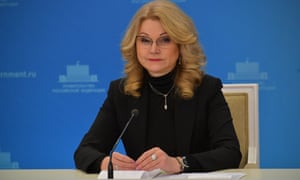
“More than 81% of this increase in mortality over this period is due to Covid,” said the deputy prime minister, Tatiana Golikova, meaning that more than 186,000 Russians have died from Covid-19.
Russian health officials have registered more than 3m infections since the start of the pandemic, putting the country’s caseload at fourth-highest in the world.
But they have only reported 55,265 deaths – a much lower fatality rate than in other badly hit countries.
Russia has been criticised for only listing Covid deaths where an autopsy confirms the virus was the main cause.
Alexei Raksha, a demographer who left Rosstat in July, told AFP last week that the Russian health ministry and the consumer health ministry falsify coronavirus numbers.
Rosstat’s new figures mean that Russia now has the world’s third-highest Covid-19 death toll behind the US with 333,140 and Brazil with 191,139, according to an AFP count.
Russian authorities are holding out against reimposing a nationwide lockdown. The Kremlin hopes to buttress the struggling economy even as the country is battered by a second wave of infections.
Russia’s government predicts the economy will shrink by 3.9% this year, while its central bank expects an even deeper decline.
During his end-of-year press conference earlier this month, Putin rejected the idea of imposing the kind of lockdown many European countries introduced going into the Christmas holidays.
“If we follow the rules and demands of health regulators, then we do not need any lockdowns,” he said.
While strict measures have been imposed in some big cities, authorities in many regions have limited restrictions to mask-wearing in public spaces and reducing mass gatherings.
But many Russians flout social distancing rules, and in recent weeks the country’s outbreak has overwhelmed poorly funded hospitals in the regions.
Russia has instead pinned its hopes on corralling its outbreak by vaccinating people with its Sputnik V jab, named after the Soviet-era satellite.
The country launched a mass vaccination programme earlier this month, first inoculating high-risk workers aged 18-60 without chronic illnesses.
Over the weekend, the over-60s got the green light to receive the shot.
On Monday, Sputnik V’s developer, the state-run Gamaleya research centre, said that around 700,000 doses had so far been released for domestic use.
However, Russia has not said how many people it has vaccinated so far, and according to recent surveys by state-run polling company VCIOM and the Levada polling agency only 38% of Russians plan to get the shot.

The South African Covid-19 cases has surged and has taken the country to over a million confirmed cases.
The President Cyril Ramaphosa has with immediate effect schedule an emergency meeting with the coronavirus command council.
The new variant of the coronavirus is more contagious and has quickly become dominant in different countries according to experts.
The strict warning came as South Korea became the latest country to detect cases of the variant that is believed to have originated in the UK.
With the South African’s hospitals reaching full capacity and with no sign of the new surge reaching a peak, The president is expected to announce a return to restrictive measures designed to slow the spread of the disease.
“We are not helpless in the face of this variant,” infectious disease specialist, Dr Richard Lessells told Associated Press. “We can change our behavioural aspect to give the virus less opportunities to spread.” He said it was most important to avoid contact with others in indoor, enclosed spaces.
South Africa has announced a cumulative total of over 1,000,000 confirmed cases of Covid-19 over the weekend, it includes 26,735 deaths in a country of 60 million citizens.
“One million cases is a huge milestone, but the true figures of cases and deaths is almost certainly much higher,” Lessells said.
“As different people return from their various holidays, we expected them to bring the variant with them,” said Lessells. “We can also expect travelers to take the variant with them across the borders to other African nations.”
Medic clinic International is among the top three private hospital networks in the country. It is said over the weekend that a severe rise in cases had placed a very heavy strain on available healthcare resources including staff, equipment and beds to provide intensive treatment for seriously ill patients.
“The numbers of patients seeking care within our hospitals has exceeded previous numbers during the first peak and the majority of our ICU and high-care units are operating at capacity,” the company said, referring to the Western Cape province.
The mutation of the Covid-19 virus has made it bind more efficiently to cells within our bodies, say experts.
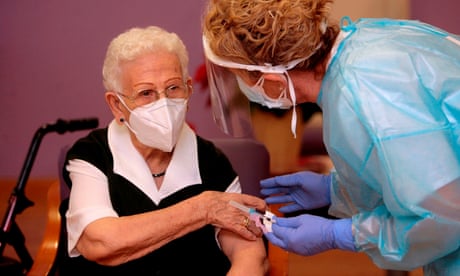
Vaccinations is yet to bi in South Africa, though the president said he expects 10% of the country’s 60 million people to be inoculated in the first months of 2021.
South Africa’s seven-day rolling average of daily new cases has nearly doubled over the past two weeks from 10.24 new cases per 100,000 people on 12 December to 19.86 new cases per 100,000 people on 26 December. The number of deaths has also nearly doubled with the seven-day rolling average of daily deaths in South Africa has risen over the past two weeks from 0.25 deaths per 100,000 people on 12 December to 0.48 deaths per 100,000 people on 26 December.
In South Korea, health authorities on Monday confirmed three cases of a particularly infectious coronavirus variant that recently emerged in Britain.
The three individuals are members of a London-based family who arrived in the country on 22 December, according to the Korea Disease Control and Prevention Agency.
They have been placed in isolation since testing positive for Covid-19 on arrival, the KDCA statement said.
The new strain of the virus emerged earlier this month in Britain and has already reached several European countries, as well as Canada, Jordan and Japan.
The new strain, which experts fear is more contagious, prompted more than 50 countries to impose travel restrictions on Britain.
SOURCE: THE GUARDIAN