Human breast milk is the milk produced by the breasts (or mammary glands) of a human female for her infant offspring. Milk is the primary source of nutrition for newborns before they are able to eat and digest other foods; older infants and toddlers may continue to be breastfed, either exclusively or in combination with other foods.
Benefits
The baby nursing from its own mother is the most common way of obtaining breast milk, but the milk can be pumped and then fed by baby bottle, cup and/or spoon, supplementation drip system, and
nasogastric tube.
Breast milk can be supplied by a woman other than the baby's mother; either via donated pumped milk (for example from a milk bank), or when a woman nurses a child other than her own at her breast — an ancient and storied practice known as wetnursing.
The World Health Organization
recommends exclusive breastfeeding for the first six months of life,
with solids gradually being introduced around this age when signs of
readiness are shown.
Supplemented breastfeeding is recommended until at
least age two and then for as long as the mother and child wish.
Breastfeeding offers health benefits to mother and child even after toddlerhood.
These benefits include a somewhat lowered risk of
Sudden Infant Death Syndrome (SIDS),
increased intelligence,
decreased likelihood of contracting middle ear infections,
cold and flu resistance,
a tiny decrease in the risk of
childhood leukemia,
lower risk of childhood onset diabetes,
decreased risk of asthma and eczema,
decreased dental problems
decreased risk of obesity later in life,
decreased risk of
autism,
and a decreased risk of developing psychological disorders, particularly in adopted children.
Breastfeeding also provides health benefits for the mother. It
assists the uterus in returning to its pre-pregnancy size and reduces
post-partum bleeding, as well as assisting the mother in returning to
her pre-pregnancy weight. Breastfeeding also reduces the risk of breast
cancer later in life.
Production

When the baby sucks its mother's breast, a
hormone called oxytocin compels the milk to flow from the alveoli,
through the ducts (milk canals) into the sacs (milk pools) behind the
areola and then into the baby's mouth
Under the influence of the hormones
prolactin and
oxytocin, women produce milk after
childbirth to feed the
baby.
The initial milk produced is referred to as
colostrum, which is high in the
immunoglobulin IgA, which coats the
gastrointestinal tract. This helps to protect the newborn until its own
immune system is functioning properly, and creates a mild laxative effect, expelling
meconium and helping to prevent the build-up of
bilirubin (a contributory factor in
jaundice).
Actual inability to produce enough milk is rare, with studies showing
that mothers from developing countries experiencing nutritional
hardship still produce amounts of milk of similar quality to that of
mothers in developed countries.
There are many reasons a mother may not produce enough breast milk.
Some of the most common are an improper latch (i.e., the baby does not
connect efficiently with the nipple), not nursing or pumping enough to
meet supply, certain medications (including estrogen-containing
hormonal contraceptives), illness, and dehydration.
A rarer reason is
Sheehan's syndrome, also known as postpartum
hypopituitarism, which is associated with prolactin deficiency: This syndrome may require hormone replacement.
The amount of milk produced depends on how often the mother is nursing and/or
pumping; the more the mother nurses her baby, or
pumps, the more milk is produced.
It is very helpful to nurse on demand - to nurse when the baby wants to
nurse rather than on a schedule. If pumping, it is helpful to have an
electric high-grade pump so that all of the milk ducts are stimulated.
Some mothers try to increase their milk supply in other ways - by taking
the herb fenugreek, used for hundreds of years to increase supply
("Mother's Milk" teas contain fenugreek as well as other
supply-increasing herbs); there are also prescription medications that
can be used, such as Domperidone (off-label use) and Reglan,
however the American Academy of Pediatrics considers Reglan a “drug
whose effect on nursing infants is unknown but may be of concern."
There are concerns over the use of Domperidone as well.
Composition
Composition of human breast milk[24]
| Fat |
| total (g/100 ml) |
4.2 |
| fatty acids - length 8C (% ) |
trace |
| polyunsaturated fatty acids (%) |
14 |
| Protein (g/100 ml) |
| total |
1.1 |
| casein 0.4 |
0.3 |
| a-lactalbumin |
0.3 |
| lactoferrin (apo-lactoferrin) |
0.2 |
| IgA |
0.1 |
| IgG |
0.001 |
| lysozyme |
0.05 |
| serum albumin |
0.05 |
| ß-lactoglobulin |
- |
| Carbohydrate (g/100 ml) |
| lactose |
7 |
| oligosaccharides |
0.5 |
| Minerals (g/100 ml) |
| calcium |
0.03 |
| phosphorus |
0.014 |
| sodium |
0.015 |
| potassium |
0.055 |
| chlorine |
0.043 |
If nutrient supply is found lacking, content is obtained from the
mother's bodily stores. The exact composition of breast milk varies from
day to day, depending on food consumption and environment, meaning that
the ratio of water to
fat fluctuates.
During the first few days after delivery, the mother produces
colostrum.
This is a thin yellowish fluid that is the same fluid that sometimes
leaks from the breasts during pregnancy. It is rich in protein and
antibodies that provide passive immunity to the baby (the baby's immune
system is not fully developed at birth). Colostrum also helps the
newborn's digestive system to grow and function properly.
Colostrum
will gradually change to become mature milk. In the first 3–4 days it
will appear thin and watery and will taste very sweet; later, the milk
will be thicker and creamier. Human milk quenches the baby's thirst and
hunger and provides the proteins, sugar, minerals, and antibodies that
the baby needs.
In the 1980s and 1990s, lactation professionals used to make a
differentiation between foremilk and hindmilk. But this differentiation
causes confusion as there are not two types of milk. Instead, as a baby
breastfeeds, the fat content very gradually increases, with the milk
becoming fattier and fattier over time.
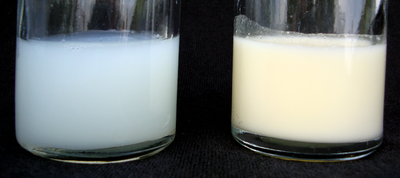
Two 25-milliliter samples of human breast milk. The lefthand sample is foremilk and the righthand sample is hindmilk.
The level of
Immunoglobulin A (IgA) in breast milk remains high from day 10 until at least 7.5 months post-partum.
Human milk contains 0.8% to 0.9% protein, 4.5% fat, 7.1% carbohydrates, and 0.2% ash (minerals).
Carbohydrates are mainly
lactose; several lactose-based oligosaccharides have been identified as minor components.
The fat fraction contains specific
triglycerides of
palmitic and
oleic acid (O-P-O triglycerides), and also quite a large quantity of lipids with trans bonds (see:
trans fat) that are considered to have a health benefit.
They are
vaccenic acid, and
Conjugated linoleic acid (CLA) accounting for up to 6% of the human milk fat.
The principal proteins are
casein (
homologous to bovine beta-casein), alpha-
lactalbumin,
lactoferrin (apo-lactoferrin),
IgA,
lysozyme, and
serum albumin. In an acidic environment such as the
stomach, alpha-lactalbumin
unfolds into a different form and binds
oleic acid to form a complex called
HAMLET that kills
tumor cells. This is thought to contribute to the protection of breastfed babies against cancer.
Non-protein nitrogen-containing compounds, making up 25% of the milk's nitrogen, include
urea,
uric acid,
creatine,
creatinine,
amino acids, and
nucleotides.
[31][32] Breast milk has
circadian variations; some of the nucleotides are more commonly produced during the night, others during the day.
Mother's milk has been shown to supply a type of
endocannabinoid (the natural neurotransmitters that
marijuana simulates),
2-Arachidonoyl glycerol.
At one time it was thought that breast milk was
sterile, however it is now known that it is more similar to cultured
yogurt,
containing as many as 600 different species of beneficial bacteria. It
is also now known that breast milk contains a unique type of sugars,
oligosaccharides,
which are long chains of complex sugars.
So far scientists have
identified 140 of them and estimate there are about 200. These types of
sugars are found nowhere else in nature, and not every mother produces
the same ones, since they vary by blood type.
However, the
oligosaccharides are not digestible by infants and are instead meant to
feed the beneficial bacteria that live in the intestine and help to
fight infections.
Also found in breast milk are endo-
cannabinoids,
which may act as an appetite stimulant, but they also regulate appetite
so infants don't eat too much. That may be why formula-fed babies have a
higher caloric intake than breastfed babies.
The breast milk of diabetic mothers has been shown to have a
different composition from that of non-diabetic mothers. It may contain
elevated levels of glucose and insulin and decreased polyunsaturated
fatty acids.
A dose-dependent effect of diabetic breast milk on
increasing language delays in infants has also been noted, although
doctors recommend that diabetic mothers breastfeed despite this
potential risk.
Though it now is almost universally prescribed, in some countries in the 1950s the practice of
breastfeeding went through a period where it was out of vogue and the use of
infant formula
was considered superior to breast milk. However, it is now universally
recognized that there is no commercial formula that can equal breast
milk.
In addition to the appropriate amounts of
carbohydrate,
protein, and
fat, breast milk provides
vitamins,
minerals,
digestive enzymes,
[37] and
hormones.
Breast milk also contains antibodies and lymphocytes from the mother that help the baby resist infections.
The immune function of breast milk is individualized, as the mother,
through her touching and taking care of the baby, comes into contact
with pathogens that colonize the baby, and, as a consequence, her body
makes the appropriate antibodies and immune cells.
Breast milk contains less iron than formula, as iron is an essential nutrient for the survival of pathogens inside a host.
However, the iron supplied in breast milk is more available to the
infant than that supplied in formula feedings or supplements.
At around
four to six months of age the internal iron supplies of the infant, held
in the hepatic cells of the liver, is exhausted, hence this is the time
that complementary feeding is introduced.
Women
breastfeeding should consult with their physician regarding substances that can be unwittingly passed to the infant via breast milk, such as
alcohol, viruses (
HIV or
HTLV-1) or medications.
Most women that do not breastfeed use
infant formula, but breast milk donated by volunteers to human milk banks can be obtained by prescription in some countries.
Mother's breast milk provides a higher proportion of cholesterol than
almost any other food. It also contains over 50% of its calories as
fat, much of it saturated fat.
Both cholesterol and saturated fat are
essential for growth in babies and children, especially the development
of the brain.
Most commercial formulas are low in saturated fats and soy
formulas care completely devoid of cholesterol. A recent study linked
lowfat diets with failure to thrive in children.
Storage of expressed breast milk

Bottle of Pumped Breast Milk
Expressed breast milk can be stored for later use. It is recommended
that the milk be stored in hard-sided containers with airtight seals.
Some plastic bags specifically manufactured for the storage of expressed
breast milk are designed for storage periods of less than 72 hours -
others can be used for up to 6 months if frozen.
The amount of time that it can be safely stored for use by infants in a home-based situation is given in this table.
| Place of storage |
Temperature |
Maximum storage time |
| In a room |
25°C |
77°F |
Six to eight hours |
| Insulated thermal bag with ice packs |
|
|
Up to 24 hours |
| In a refrigerator |
4°C |
39°F |
Up to five days |
| Freezer compartment inside a refrigerator |
-15°C |
5°F |
Two weeks |
| A combined refrigerator and freezer with separate doors |
-18°C |
0°F |
Three to six months |
| Chest or upright manual defrost deep freezer |
-20°C |
-4°F |
Six to twelve months |
Comparison to other milks
All
mammalian
species produce milk, but the composition of milk for each species
varies widely and other kinds of milk are often very different from
human breast milk. As a rule, the milk of mammals that nurse frequently
(including human babies) is less rich, or more watery, than the milk of
mammals whose young nurse less often.
Human milk is noticeably thinner
and sweeter than cow's milk.
Whole cow's milk contains too little
iron,
retinol,
vitamin E,
vitamin C,
vitamin D,
unsaturated fats or essential
fatty acids for human babies.
Whole cow's milk also contains too much
protein,
sodium,
potassium,
phosphorus and
chloride which may put a strain on an infant's immature
kidneys. In addition, the proteins, fats and
calcium in whole cow's milk are more difficult for an infant to digest and absorb than the ones in breast milk.
Evaporated milk
may be easier to digest due to the processing of the protein but is
still nutritionally inadequate. A significant minority of infants are
allergic to one or more of the constituents of cow's milk, most often the cow's milk proteins.
These problems can also affect
infant formulas derived from cow's milk.
Alternative uses for breast milk
In addition to providing essential nourishment to infants, human
milk; i.e., breast milk, has a number of valuable uses, especially
medicinal uses, for both children and adults. It has been used
medicinally for thousands of years.
Breast milk contains strong
antibodies and
antitoxins
that many people believe promote healing and better overall health.
However, breast milk lacks sterile and antiseptic properties if a
nursing mother is infected with certain
communicable diseases, such as
HIV and CMV, as breast milk can transmit such diseases to infants and other people.
Breast milk has been used as a home remedy for minor
ailments, such as
conjunctivitis,
insect bites and stings,
contact dermatitis, and infected
wounds,
burns, and
abrasions. Breast milk has also been used
alternatively to boost the
immune system of ill persons having
viral gastroenteritis,
influenza, the
common cold,
pneumonia, etc., because of its
immunologic properties. However, breast milk should never be seen or construed as a "cure-all". Some medical experts are convinced that breast milk can induce
apoptosis in some types of
cancer cells. However, more research and evidence are needed in this area of cancer treatment.
A minority of people, including
restaurateur Hans Lochen of
Switzerland and
restaurateur Daniel Angerer of
Austria,
who operates a restaurant in New York City, have used human breast
milk, or at least advocated its use, as a substitute for cow's milk in
dairy products and food
recipes.
Tammy Frissell-Deppe, a family counselor specialized in
attachment parenting, published a book, titled
A Breastfeeding Mother's Secret Recipes, providing a lengthy compilation of detailed food and beverage recipes containing human breast milk.
The
animal rights organization known as
PETA
ignited a firestorm of criticism when it urged a dairy company to
replace the cow's milk they use in their ice cream products with human
breast milk as a way to stop cattle abuse.
Human breast milk is not produced or distributed industrially or
commercially, because the use of human breast milk as an adult food is
considered unusual to the majority of civilized
cultures around the world, and most disapprove of such a practice.
Attempts to formulate
soap from breast milk have also been made, and those using it claim that its effectiveness as a
cleanser is greater than, or equal to, that of traditional soaps.
Importance of breastfeeding
It is generally accepted that breastfeeding is very important in the
early period of life. Furthermore, it has potentially long-lasting or
lifelong biological effects in one's life.


